(2014)
First published as an audio story for Palaver Press. Best read with Scott Joplin – Bethena: A Concert Waltz on the side
The view of the Cross Hill Lake lay in its serenity. The sparkling sun on the water surface enticed anyone to dip in and cool the heat. The shades from the pine trees gave options to that, too. Leaves and branches swift gently towards each other and their shadows created a dancing performance. From the window of his shack, Lou stared at this view in silence.
The shack had been Lou’s workshop for almost a decade. He liked that it was hidden from the world, so that he could establish his own rules and regulations. These days the floor had been hardly visible as woods from different shapes, thickness, and sizes piled up. Strings were hanging on any possible spots that they could be hung. The ones that dangled near the wooden windowsill created this dramatic strays of shadow whenever the sun struck. Its silhouette shifted following the time of the days. Papers filled with sketches and scribbles of measurement scattered here and there – on the desk, on top of the counter, and sometimes stuck in between the piling woods. There was an eerie yet warming feeling in this chaos.
His mind wandered. His wife Jackie would come home in a few hours. He would need to finish the mess he made or he would get in trouble. But he had not figured out how to build this piano. All the components were the same; the measurements were exact to their every inch yet he found flaws in the piano’s resonation. ”What could have I done wrong?” he asked himself as the frustration was unprecedented.
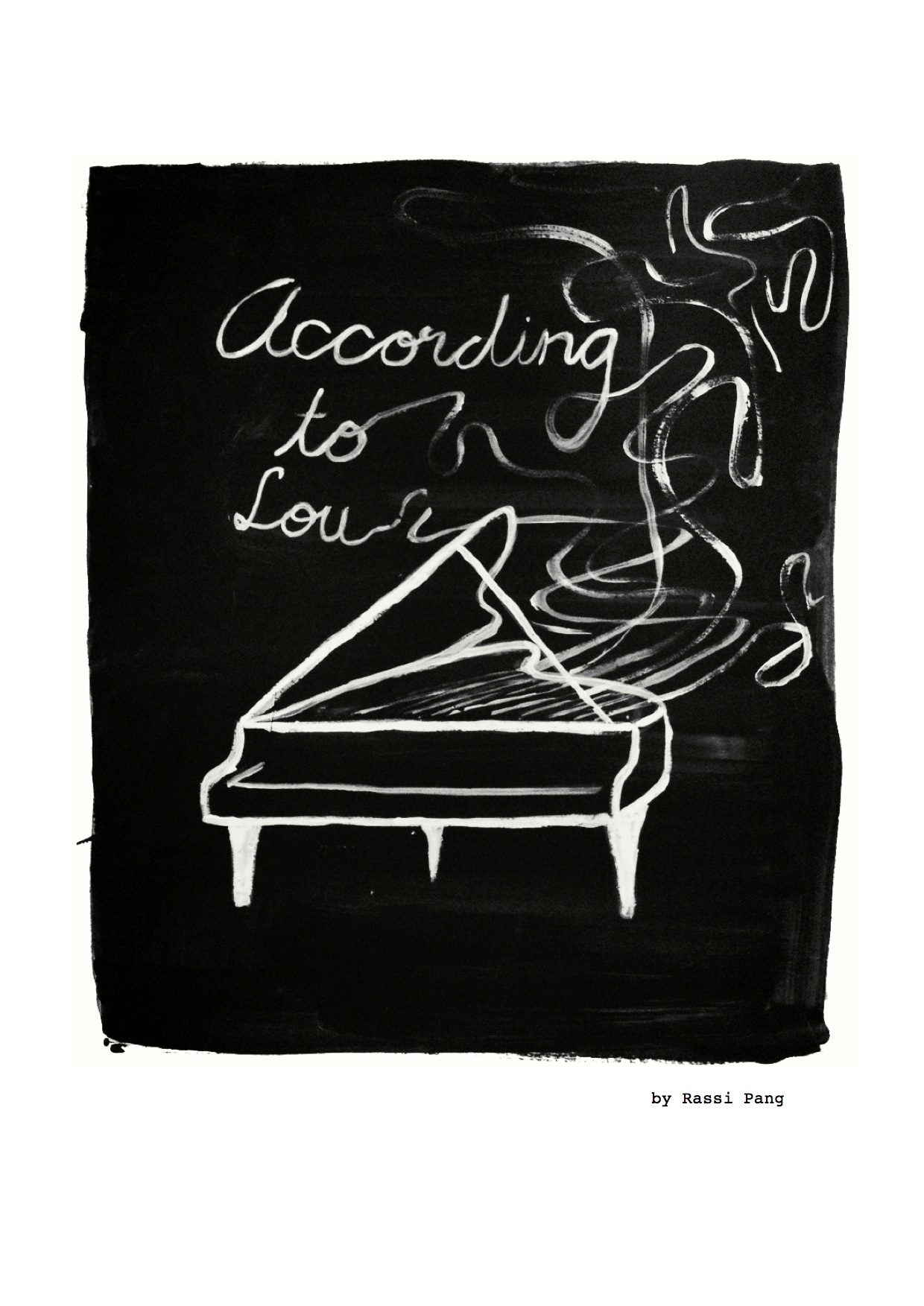
He walked to the almost finished grand piano at the corner of the workshop, hit a middle C, and the rumbling sound came. It sounded like a standard C for most people, but according to Lou, there was a grudge – an unfinished tale. He hit a high G and again there was absence in the existence of the sound it created.
To solve the problem, Lou opened the lid of the instrument, exposing strings that were beautifully arranged. His head moved forward, closer to examine. However, when his finger hit the key and he pressed the pedal with his foot, he lost his balance. He tried to find a grip but his head fell first to the inside of the piano. He automatically covered his head with his hand to anticipate the lid that would fall on top of him. But as he opened his eyes, he realized that he was instead floating in a fetal position in the darkness. He adjusted his eyes to see around and noticed there were stars above him and shooting stars were coming to his direction.
He once saw a meteor crater in Texas and was blown away to the size of it. So he could imagine what would have happened if it came to hit him right then. Indeed, the falling star passed by close enough to where he was. He noticed they had tails made out of strings just like the ones he put inside the piano. They were soft and strong altogether as he reached out his hand to touch it.
Lou then tried to – what he thought as the posture of – standing up. He bended his knees, pushed his weight down to the leg, and his head upward to the sky. He walked without knowing exactly where he was heading. The corner of his eyes captured a slight movement. A shadow seemed to appear in the already pitch black space. He became cautious. When the shadow came again, Lou decided to approach. He kept walking until he came to a park. The movement disrupted his eyes again, this time it was closer.
He entered the park and saw a fox was looking back at him. Then, a voice came to his head, “Follow me.” He tried to make sense, yet the only sense at that particular moment was to follow the animal that was talking to him.
“You must be wondering where you are right now,” said the fox as he led walking. Lou was indeed curious. The park was big enough to be woods and its ground was filled with broken branches that were covered with moss – or so Lou hoped it was branches and moss.
“We need to go fast. We’re almost late. You need to meet him before you go back,” marked the fox. Every five minutes the fox’s head turned to check if Lou was still behind his feet.
They must have walked for at least thirty minutes before Lou found himself at the edge of the woods. A dirt road stood between him and a small brick house with a front yard. Lights were coming out of the windows, but from one particular window the candlelight seemed to flicker. Lou went closer and silently peeped in to see a black man of forty sobbed inside his working room. He was shaking uncontrollably.
The crying man did not care on the beautiful summer that the night offered. He was sitting in front of the piano in the room, and started to hit the keys. There was rage as he was playing. The noise was harrowing but surprisingly beautiful. He slowed down and started to hit the tone of high A and G. He did it over and over again. In the following repetition he hummed along. The gesture was made while tears streamed down to his face.
The repetition of these two notes captivated Lou. In doubt, he looked at the fox to make sure. The fox nod in reply before heading back to the woods. Hence, Lou crossed the yard to look closer. Pressing his hands to the brick wall and his face to the glass of the window, Lou’s body fused with the house and he found himself inside the room with the man.
Lou stood in silence; he dared not to make a move. It was the longest silence in his life. Hesitantly, Lou greeted, “Excuse me.” The man did not seem to hear Lou, or perhaps he just did not care that Lou was there. He kept on hitting the keys he was playing.
Lou glided his eyes, scanning the room. It looked like his workshop. Of course there were books instead of woods. But the were also papers here and there, only they were filled with compositions not measurements. He walked to the desk and saw a wedding picture in frame lied on it. It was the picture of the man at the piano with a beautiful young bride that gleefully clung his arm.
His attention was drawn back to the soft sound of the piano. The key had grown into a tune. The man smiled while he closed his eyes. A composition was derived with a benign nostalgic remnant that told this: the story of the first time the eyes met, the dance that led to the first kiss, the holding hands on the prairie, and the troubling heart of a fight.
When the piece came back to its first verse, a twirling anguish somehow fit between the exact chords that previously portrayed joy and innocence. Oddly enough, the symphony became a tale of distress and intense separation. Lou did not know how he came to that conclusion, he just understood.
At this time, Lou looked down to the frame of picture he was holding in his hand. His eyes traveled through the image and continued to a newspaper on the desk. The Missouri Herald of September 10, 1904. The face of the bride was depicted under the obituary section. It said: “Frederica Joplin, 19 years old, a loving wife.”
Intense emotion surpassed whichever dimension Lou was in. He closed his eyes and drowned himself in wistful thinking, melted away with his muse and his tune. Gradually, he felt the pain of the music came into being; the man’s anguish intercepted his body. It hurt Lou from the point of his fingers; traveled to his vein and all the way to his chest. He was suffocating. His eyes felt heavy and everything that he saw was spinning rapidly. The wedding picture dropped from his hand to the floor. As the glass of the frame spattered, the man stopped his performance and finally looked at Lou’s direction for the first time. He stared directly into Lou’s eyes and asked, “Who are you?”
At that moment, the whole room fused. Every thing was dissolved and Lou felt nauseated. He was trying to find a place to hold on. “The desk,” he thought, as it was close enough to where he was standing. But, when his hand reached out he found nothing but hollowness and horror. That was the right way to put it. Lou had no concept of time, space, or being. He could only acknowledge an immense fear. The darkness he was in was not even like it was the first time – with the stars and meteors. This time, there was nothing. He tried to open his eyes, moving the nerves around his eyes that he thought he used when Jackie forced him to wake up in the morning. He tried and failed and tried and failed. He cursed in hope that he could hear his own voice. But nothing was heard, except for a whisper calling his name. “Lou.”
Was it a whisper? He was not sure. He tried to open his eyes again. A little improvement, there was a slight light in where his eyes were. The light was in the shade of red. Again the whisper came, calling his name.
On the second whisper, Lou felt a sting of pain in his back and pressure of strings on the right side of his face. His sight was blurred, but he managed to recognize speckles of bloods staining the strings of the piano. His brain told him to move his hand and feet, but the designated organs could not receive these signals. The piano lid hugged him too close that his breath became heavy and apart. And then he realized that the voice did not come as a whisper, it was a scream.
Lou hoped Jackie did not scream because of the mess he made. He did not have the time to fix it and she was a bit early anyway, said Lou to himself. He tried to recite excuses in his head to avoid her comments. “I could tell that I got stuck working on the piano,” he thought. He realized how funny that would have sounded as he was literally and figuratively got stuck in his work.
His head felt like it was stabbed with knives. But he had been in worse pain. So he only felt really tired and wanted a deep long nap.
As he tried to catch the air, someone lifted the piano lid. “That felt good.” He could breathe better now. But as the pressure was raised, the contrary occurred; a strong force pulled the air that had gone all the way through his nose and filled his lung. He gasped, in an attempt to block his throat, so he could keep some air in, but the force was too strong; he was losing the tug of war.
When the last air was pulled out of his nostril, Lou saw Jackie from the side of the piano. She looked panic. Jackie’s face was super imposed by the red shade of his sight. Her mouth was moving but no sound came to his ear. “I’m just going to rest for a while, Jackie,” said Lou – or so Lou thought he was saying as no words actually came out. What Jackie saw was a slight mouth movement as his eyelids closed in between the drip of blood from his head.
In his sleep Lou felt like fusing again with the strings that had already became his bed. He did not twirl like before, he melted. He recognized the calm and at the same time identified that feeling of separation. Then from afar, came that familiar tune: a soft A and G, played repeatedly in agony.
 rassinarika.com