“(S)he was still twelve or thirteen, exactly as I had seen her twenty years before, ‘You haven’t changed at all,’ I said to her, and she said, ‘You’re so much older than you were.”
–
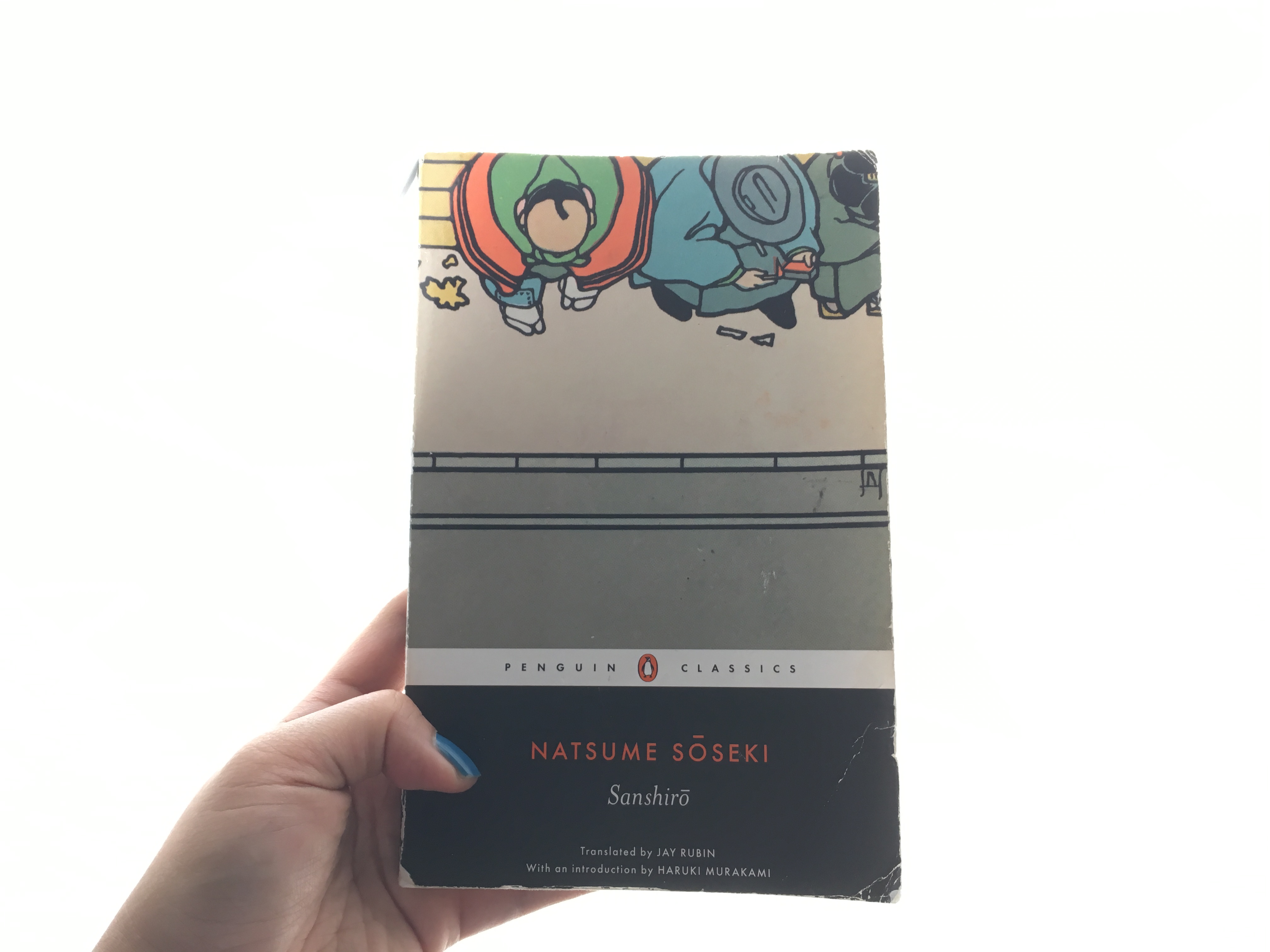
It took me a while to start and complete reading this book. I always judge a book by its first couple of page I strived reading it initially because Haruki Murakami made the preface of Sōseki’s importance to Japanese literature. I feel that the book reflects is something cultural: the absence of abrupt conflict, the subtleness of communication, the quiet mediation; and since I’m more familiar with Western authors and their style of writings, Sōseki’s felt flat and gray. Try imagine Japanese grey, pastel colour tone on their pottery to a western more vibrant colours; that’s how I feel about this book. Yet, just like its pottery, Sanshiro is beautiful. It embraces the slowness to capture the beauty of the setting, not just of the place, but also of the emotion.
The beauty of places were so spellbinding for my mind’s eyes that at times Sōseki left me forgetting the event Sanshirō was actually in. The emotions were delivered with words so delicate that I feel its layers would be shattered to pieces had I not handle it carefully. The writing: slow, flirtatious, consenting – all at the right moment – lead me to the imagery of emotions that we sort of knew but never had been articulated with such beautiful fragility.
–
“Then I asked her, ‘Why haven’t you changed?’ and she said, ‘Because the year I had this face, the month I wore these clothes, and the day I had my hair like this is my favourite time of all.’ ‘What time is that?’ I asked her. ‘The day we met twenty years ago,’ she said. I wondered to myself, ‘Then why have I aged like this?’ and she told me, ‘Because you wanted to go on changing, moving toward something more and more beautiful.’ Then I said to her, “You are a painting,” and she said, ‘You are a poem.’”
 rassinarika.com
Leave a comment