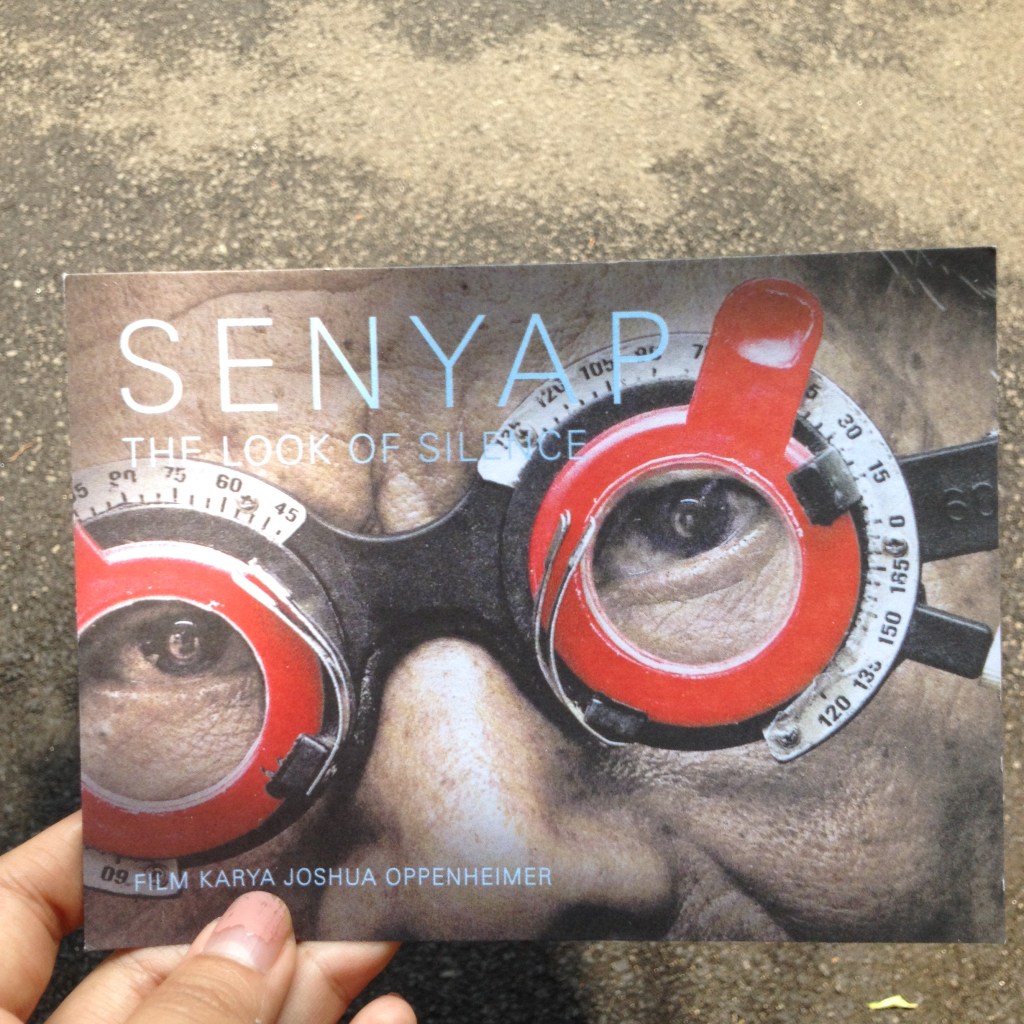
“Senyap” (The Look of Silence) is Joshua Oppenheimer’s second documentary movie after Jagal (The Act of Killing). Both movie took Indonesia’s harrowing social-political turbulence in the years following 1965. The abolishment of communism through the annihilation of people who were connected or thought to have any connections with the communist party took place, It was said to have taken the lives of hundreds and thousands of people and affected families, relatives, and those who survived the physical oppression.This part of the history still comes in puzzle comprising many theories and arguments almost fifty years after. Too many was still untold and unrevealed.
I’d been intrigued to watch Senyap (The Look of Silence as its English title) ever since I heard that Oppenheimer had more than enough materials for another follow up of The Act of Killing. This was when The Act of Killing just got launched. I waited with excitement and curious agony. Then they screened it at the Venice International Film Festival in 2014, won some awards, told the world to wait for a little while for its public screening, and I got busy preparing to leave London.
The producers previously put The Act of Killing’s file available for free download on their website for whomever entering the site from Indonesian IPs. It was and still is a sensitive matter. I was hoping to get my hand on The Look of Silence through the same offering. But, this time, they prioritise file requests for public screening to individual inquiries so that “as many Indonesians, if not all, could watch (this movie) to create the most impact”. The producers suggested watching it together to “allow audience to ‘borrow/ lend’ emotions and permit feeling to overflow,” believing it to be contagious. They open registration form for public to requests the movie’s file in exchange of information provision on when and were the movie they provide will be screened. They then would provide this information on their website so public could get in touch with Organisers. The only thing with this manner was it made screenings prone to be halted by those who stand at the other side of the line. A flow of ‘actions’ had taken place on December 10th, when many screenings took place in tribute of the Universal Human Rights Day and had to face disruptive measures.
(The ‘Nonton’ section in Senyap’s website had no screening information when this writing was made.)
My personal recollection of watching “The Act of Killing” was a combination of: (1) watching it alone and being so overwhelmed that I had got physically tired and fell asleep halfway through the movie, (2) being the only Indonesian in a screening organised by a group of Screen Doc graduate students at Goldsmiths which led to a discussion over beers, (3) screening with a group of Indonesians at a friend’s flat in Tavistock upon which I encountered how scattered Indonesians stood in regards to this part of the history, and (4) continuously putting a perspective that dissecting the cultural platform my family had been in as the so-called Chinese Indonesians.
So all that was happening in the background. Now, along comes the story.
The storyline went following Adi a local door-to-door optometrist who lived in North Sumatra. His older brother, Ramli, died two years before Adi was born. Ramli was killed by the annihilation movement of anything and anyone related to communism. (Perhaps he was part of the local labor union, a group that badly suffers during the aftermath of G30S and the eradication of communism in Indonesia.) Ramli’s story somehow became a personification story to stand before the rest tens of thousands of people who were killed in Sungai Ular during those period of time. His story became the story, presumably the combination of the intense torture he had to suffer and the fact that it was not done underground. The perpetrator was well alive and actively involved in the society.
Adi never met his brother but his parents lived through the experience. His mother, quite healthy being “at least a hundred and ten”, resume lives while burying the memories. She admitted she could have gone mad if Adi had not been born. His father, said to be 140 years old but admitted to be “only seventeen” remained witty and loveable in the midst of his physical incapabilities and dementia. He could no longer remember what happened with Ramli.
Adi then became the subject whose part was not to give answers but to come in with questions. He had heard the stories without explanations. In the vicinity of his upbringing, I imagined Adi grew to know and not know about the things that had happened, to be adept to the art of staying silent. Taking part in quite early in Oppenheimer’s project, Adi saw videos of Oppenheimer’s meeting with members of the society who took part in the killing. Some describing his late brother as an object of their violent. He decided he wanted to broke his silence. (The footage that was shown was part of the route that Oppenheimer took at the beginning of the project which eventually led him to meet Anwar, the main character in The Act of Killing.)
The documentary went metaphorically back and forth for me. Whilst the timeline might have moved forward, I felt that every character, settings, and facial expression brought me time-travel; to the present, past, and future. It moved eloquently as Adi encountered his counterparts. There was Adi’s customer as his present; the videos, the meetings with the ‘perpetrators’, the Perpetrators, and the Parents to be his past; and his children as his future. Feeling confused and filled with questions, crawled through the ugly pain and ‘truth’, tagging us along.
There indeed was a lot of silence in the movie and in the look of its characters. The title suited well. The Indonesian title might not have the literal translation from its English version, but for me it captured its appalling notion. ‘Senyap’ means silence, but not mere silence but one that is beyond quiet; a sort of eerie silence where no sound could be heard (or made). The silence in the scenes had said more message than any words could have offered.
Despite knowing what to expect, I was untrained to the hollowness I felt afterwards. . Halfway through the movie I started to ask what was it that Adi was looking? What would be his point of letting go? I think what I was trying to figure out was my ‘now what?’ I was not expecting the gain answers, but merely to have a reference. What would come out of this? What would be my point of letting go this part of the history, if one should exist? Should I expect some truth, but what would be the truth. And do we want the truth? Would we even be ready for it?
–
I don’t have answers quite yet, so I would stop with this: I would recommend people to watch the next scheduled screening and I would close this post with remnants of the Creative Morning session I attended just last week. It was of Yaya Sung, a photographer and the theme was “Ugly”. She presented her artwork which captured her projects to unravel her question about being Indonesian while being a Chinese Indonesian; which then lead to a wider scope of humanitarian issues. Her works were simple but solid, and I could relate personally. Although I enjoyed her presentation as a whole, her opening remarks stood out for me. She opened her presentation asking what good would it be to talk about the ugly things, the ugly experience. Then, she stated how talking about it helps to deal with the pain, to see what lays beyond the obvious to find the roots of the pain, to challenge, and to discover. She said none of her projects provided answers. Yes, it opened up new questions and gave a sense of discovery, but nope, no definite answer. We agreed that perhaps we had no idea what would – or could – be the answer. Which brought me to think, would we not know the answer because we prefer not to know?
I haven’t got a clue. I’m serious. I don’t even know what’s the truth. I make peace knowing that: this is a constant search and an endless journey. I expect something would come out of it, but I don’t know what is that thing. The debate will dangle for a while, so I would bet it will be here for a while. In regards to Senyap, I’m happy that though in the midst of silence in the foreground, it started to find voice, there were noise in the background. I’m glad we’re starting to question and confront the ugly. It may not take us to the answer just yet, but at least a tad closer?
 rassinarika.com
Leave a comment